Somebody made these, and you can still say their names
Alien Hominid Started on Newgrounds in 2002 and Shipped on Three Consoles Two Years Later
A single Flash game posted to Newgrounds became a retail product on three consoles — one of the earliest documented paths from browser to boxed software.
From Newgrounds to Living Room
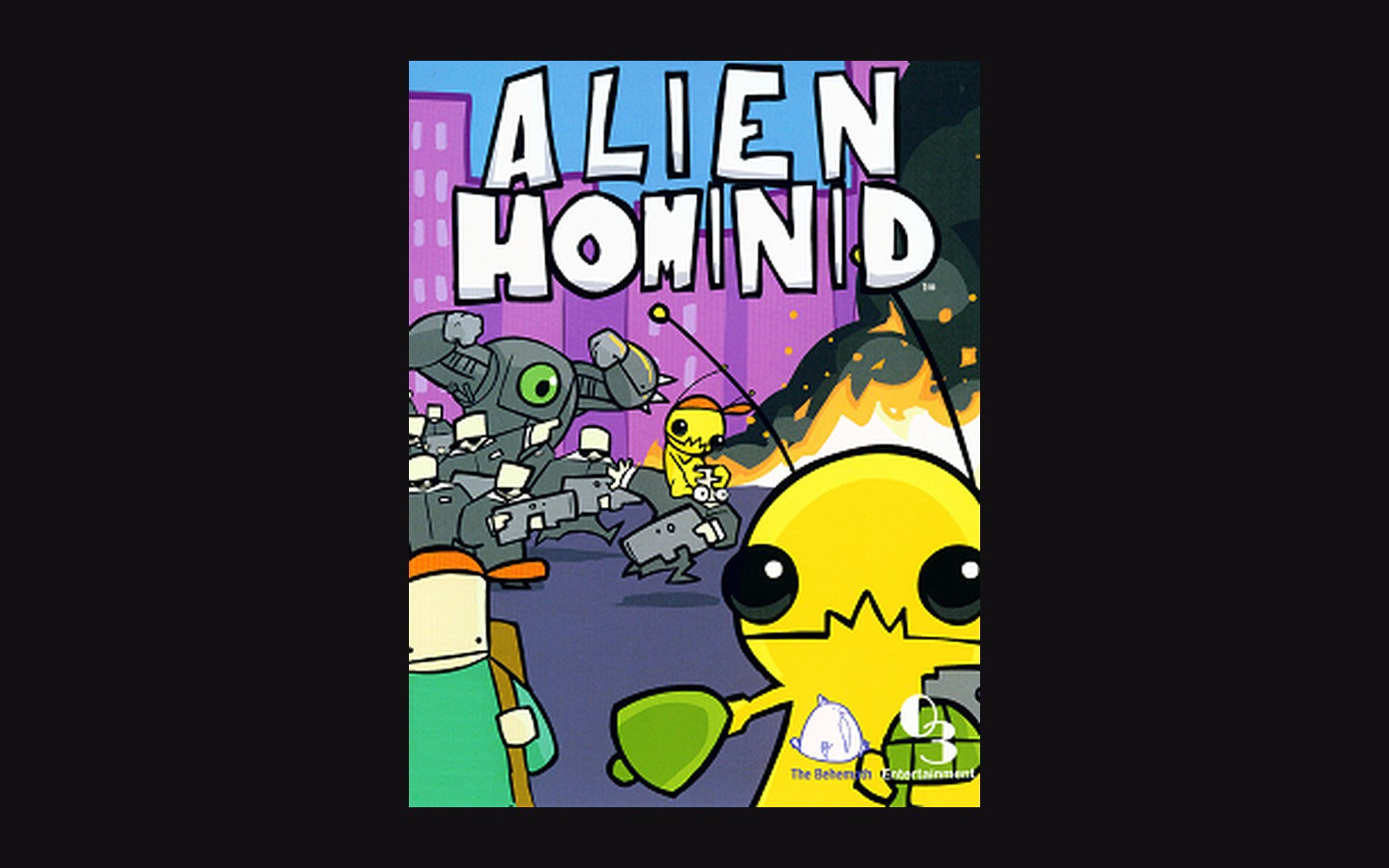
Tom Fulp posted Alien Hominid to Newgrounds on 30 August 2002. The game was made by Dan Paladin, who handled the art, and Fulp himself, who wrote the code — a straightforward run-and-gun in which a small, yellow extraterrestrial shoots federal agents across side-scrolling stages. The Flash version ran inside a browser window, controlled with a keyboard, and was immediately popular enough to rank among the most-played games on the portal that year. At a time when Newgrounds was the dominant distribution channel for Flash games, that kind of traction was visible across the entire web-gaming audience.

The commercial opportunity that followed came through The Behemoth, a San Diego studio that Paladin and Fulp co-founded specifically to take the game further. The studio licensed the intellectual property from its creators — in this case the creators were also the licensors — and began the work of converting a Flash SWF into a retail product. The conversion was not a simple export. Flash's vector animation and ActionScript code had no direct path onto console hardware; the game had to be rebuilt from scratch in a language and engine appropriate for the PlayStation 2, GameCube, and Xbox.
What transferred was the visual identity. Paladin's hand-drawn animation style, built originally in Flash's timeline-based authoring environment, was reproduced frame by frame in the console version at higher resolution. The character designs, enemy types, and stage layouts followed the Flash original closely enough that players who had seen the browser version recognised the retail release immediately. What changed was everything underneath: the input model moved from keyboard to gamepad, the rendering left Flash's vector animation pipeline entirely, and the studio added a full co-operative two-player mode, PictoChat-style mini-games for the GameCube version, and a substantially expanded stage list.
Also in The Works
Jakub Dvořský Made Machinarium in Flash and It Won an IGF Grand Prize
Edmund McMillen Built the Meat Boy Prototype in Flash in 2008 Before Super Meat Boy Was a Project
The Release and Its Significance
Alien Hominid began reaching North American shelves in 2004, published by O3 Entertainment. Reviews across all three platforms noted the game's cartoon visual style as a distinguishing characteristic, and several reviewers explicitly identified its Newgrounds origin. The GameCube version received particular attention because Nintendo's platform in 2004 had a narrower selection of third-party games than its competitors; a hand-drawn action title stood out in that catalogue.
Chronology
- August 30, 2002Flash version posted to Newgrounds by Dan Paladin and Tom Fulp
- 2002–2004The Behemoth founded; console rebuild undertaken
- December 2004Retail release on PS2, GameCube, and Xbox; published by O3 Entertainment
- 2008The Behemoth releases Castle Crashers, its next major title
- Post-2021Flash original preserved via Internet Archive / Ruffle emulation
The transition mattered beyond any single review cycle. In 2002, Flash games existed in a distinct commercial universe from console games: one was free, browser-based, and distributed through portals; the other was shrink-wrapped and sold through retailers including GameStop. The idea that a game could travel from one universe to the other — and do so carrying its original visual language intact — had not been demonstrated often. Alien Hominid was a proof of concept, and the studio that built it went on to make Castle Crashers (2008) and BattleBlock Theater (2013), both of which The Behemoth released on console without any prior Flash version.
Where this sits
The named works and the named people behind them — from Xiao Xiao to Machinarium, from Tom Fulp to Jakub Dvořský.
The original Flash game remains accessible through the Internet Archive's emulated Flash collection, which uses Ruffle to run SWF files in a browser without the plug-in that was actively blocked after 31 December 2020. The two-minute browser game and the retail disc it grew into now sit in separate archives — one preserved as a historical artefact, one distributed as shrink-wrap — with the same yellow alien running through both.