Somebody made these, and you can still say their names
Jakub Dvořský Made Machinarium in Flash and It Won an IGF Grand Prize
A hand-drawn point-and-click adventure built in Flash became the most decorated independent game of 2009.
From Samorost to Machinarium
Jakub Dvorský, founder of the Czech studio Amanita Design — did not arrive at Machinarium without a body of work behind him. His first Flash project, Samorost, appeared online in 2003 as a short, wordless point-and-click puzzle built from manipulated photographs of natural objects. It circulated widely through portals and generated enough attention that Macromedia featured it as a site-of-the-day showcase. A sequel, Samorost 2, followed in 2005 with a commercial chapter appended to a free introduction, testing whether audiences would pay for Flash-native adventure games — they would.
These experiments established Dvořský's method: no text in the game world, no dialogue boxes, no inventory bars in the conventional sense. Puzzles were embedded in the environment, readable through animation cues and spatial logic rather than instruction. Flash suited this approach not because it was the only tool available but because its vector-drawing environment and timeline-based animation let a very small team — Amanita's headcount during Machinarium's development was around five people — produce hand-crafted assets at a pace that would have been commercially indefensible in a heavier production pipeline.
Building the Robot City
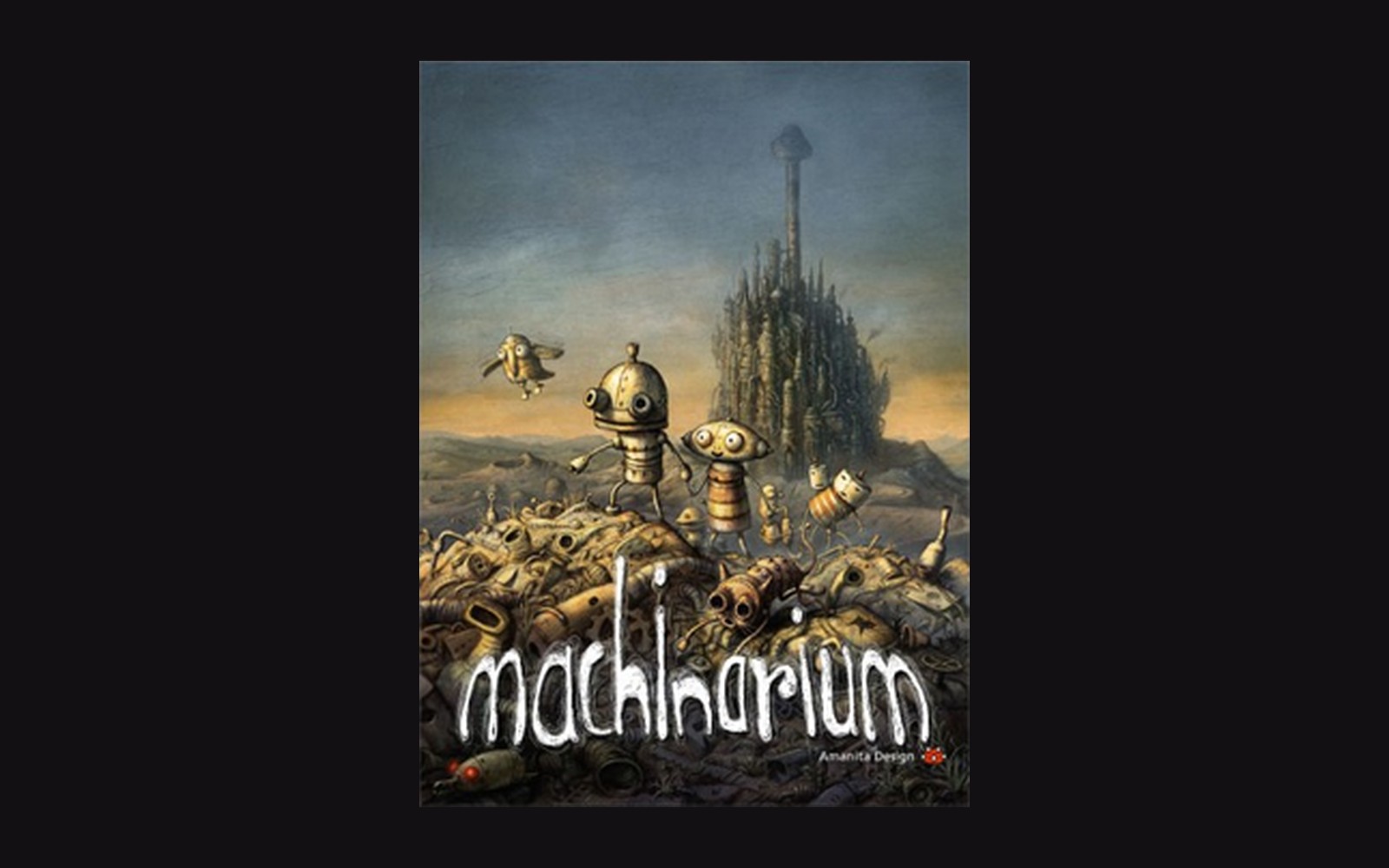
Machinarium began development in 2006 and reached release on 16 October 2009. The game's setting is an entirely mechanical city populated by robots with expressive, anatomically improbable bodies; the protagonist, a small scrap-metal robot named Josef, is disassembled and dumped outside the city walls in the opening sequence and must reassemble himself before any other goal becomes relevant. Every background in the game was drawn by hand — pencil sketches scanned and then redrawn or refined digitally — and then assembled inside Flash's authoring environment alongside the character animations.
Also in The Works
Alien Hominid Started on Newgrounds in 2002 and Shipped on Three Consoles Two Years Later
Edmund McMillen Built the Meat Boy Prototype in Flash in 2008 Before Super Meat Boy Was a Project
The visual language was legible internationally without translation, which mattered practically: Amanita was a studio in Brno with no publisher and no localization budget at launch. Flash as a distribution format meant the game could be sold directly through the studio's own site and through digital storefronts without a physical manufacturing run. The Independent Games Festival honoured Machinarium in 2010, recognising it as one of the standout independent games of the submission cycle. It also won the IGF's Excellence in Visual Art award that year — a less surprising result given the work, but a useful confirmation that adjudicators were evaluating the hand-drawn aesthetic on its own terms rather than tolerating it.
Chronology
- 2003Samorost released online; Macromedia showcases it
- 2005Samorost 2 released with a paid second chapter
- 2006Machinarium development begins at Amanita Design, Brno
- 16 October 2009Machinarium released (browser + downloadable SWF wrapper)
- March 2010IGF Grand Prize and Excellence in Visual Art awarded at GDC
- 2011iPad port released; iOS rebuild required because Flash Player was unavailable on the platform
- Subsequent yearsPlayStation 3, Vita, PS4, Android, and additional PC ports
Flash was not incidental to those awards. The IGF Grand Prize recognised the finished work, and the finished work was built in Flash, mastered as a SWF and initially delivered as a browser-playable or downloadable executable wrapping that same SWF in a standalone player. The distinction between "Flash game" and "professional product" that critics occasionally invoked held no water in Machinarium's case: the tool shaped the output and the output won.
Where this sits
The named works and the named people behind them — from Xiao Xiao to Machinarium, from Tom Fulp to Jakub Dvořský.
Ports and What They Reveal
The game's commercial success prompted a sequence of ports that illuminate how Flash sat in the wider development landscape. An iPad version appeared in 2011, rebuilt rather than emulated because Flash Player was not available on iOS — a consequence of the platform exclusion that Steve Jobs had formalised in his April 2010 open letter. Android, PlayStation 3, PlayStation Vita, PlayStation 4, and PC versions followed over subsequent years, each requiring the artwork to be exported from its original Flash source files and reintegrated into a new runtime. That process was labour-intensive enough to be noteworthy, but the original assets survived it: the hand-drawn frames did not need to be redrawn, only re-encoded.
What this history demonstrates is that Flash's authoring environment had real professional capability — not in spite of its browser-game reputation but alongside it. Dvořský used the same tool that hosted throwaway portal content to produce a game that held its visual quality across a decade of platform migrations, because vector artwork and carefully managed bitmap assets scale in ways that pixel-art tied to a specific resolution does not. Machinarium still sells on Steam. The Flash source is not what players encounter now, but it is where the game was made, and the game is still there.