Somebody made these, and you can still say their names
Brad Borne Drew Fancy Pants Man in Flash and the Physics Are Still Argued About
A solo developer's 2006 platform game became a case study in handcrafted momentum — and the drawing tools did as much work as the code.
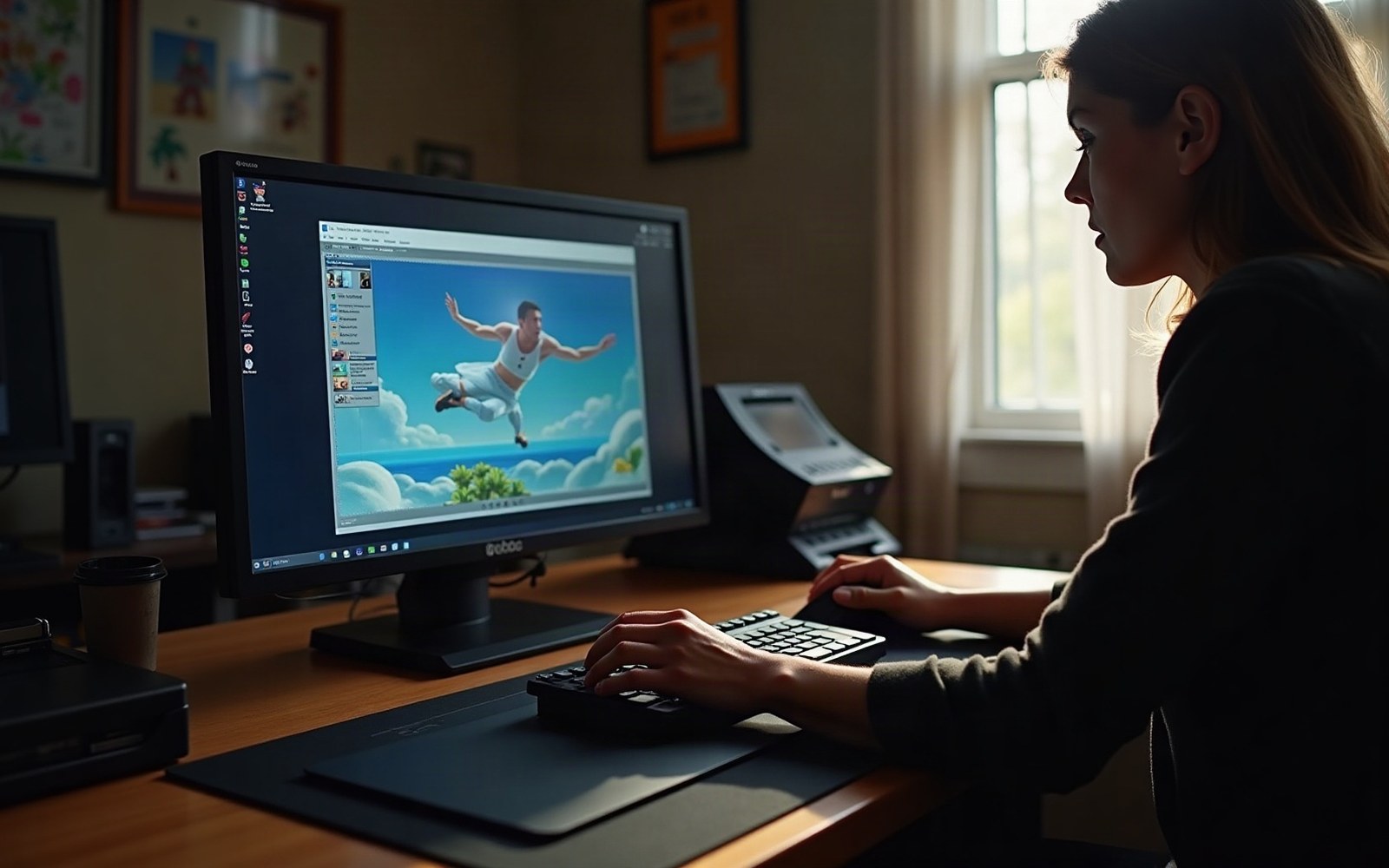
From Stage to ActionScript
Brad Borne released the first Fancy Pants Adventures on Newgrounds in 2006, drawing every frame of its spiky-haired protagonist directly in Flash's vector drawing tools. No external assets, no sprite sheets imported from elsewhere — the character lived as native Flash symbols, scaled and transformed at runtime without pixelation. That resolution-independence, a consequence of Flash's vector animation model, gave the game its clean look at any window size and cost almost nothing in file size on slow connections.
What made players argue, then and since, was the movement. Borne built a momentum system in ActionScript that accumulated and bled speed gradually rather than snapping to fixed velocities. The character's scarf animated as a trailing echo of that acceleration, making physics legible through illustration. Crucially, the system was designed to remain consistent across different frame rates — a genuine engineering problem in ActionScript 2, where a game running at 30 fps on one machine and 24 fps on another could otherwise produce different jump arcs. Borne solved this by tying velocity calculations to elapsed time rather than frame count, a technique the platform-game community on Newgrounds discussed at length because so few browser games of that era bothered.

The second entry in the series, World 2, arrived in 2008 and expanded the level design without abandoning the handmade aesthetic. Both games circulated widely through Flash portals and attracted enough attention that Electronic Arts published a console version — The Fancy Pants Adventures — for PlayStation 3 and Xbox 360 in 2011, a commercial pathway that mirrored the route Alien Hominid had taken years earlier.
Also in The Works
Alien Hominid Started on Newgrounds in 2002 and Shipped on Three Consoles Two Years Later
Jakub Dvořský Made Machinarium in Flash and It Won an IGF Award for Visual Art
The Flash originals remain significant not as technical spectacle but as evidence of what a single developer could do with Flash's authoring tools when the drawing environment and the physics logic were treated as a single system. Borne never reached for a middleware engine; the physics emerged from ActionScript, and the feel of the game emerged from the drawing.